Why Your LinkedIn Posts Get Engagement But No Leads
Inspect the path from a useful post to a suitable inquiry, with a five-post audit and examples that make the gaps easier to spot.
On this page
LinkedIn posts can get engagement without leads when the people responding are not potential buyers, the topic is too far from your service, or readers cannot see a relevant next step. Inspect the path from post to profile to offer before assuming you need more reach. Likes and comments tell you that people reacted; they do not establish buying intent.
This guide helps founders and consultants review content that attracts attention but produces few suitable business conversations.
Separate an audience problem from a timing problem
A post can reach a suitable buyer before that person needs your service. That is different from reaching people who would never buy it. Check both possibilities before changing your posting frequency.
LinkedIn and Edelman’s 2024 thought-leadership research describes how useful content can influence buyers who are not yet ready to act. It supports looking beyond immediate reactions. It does not tell you how many likes should turn into inquiries for your particular offer.
Use the table to choose a question to investigate. Treat each explanation as a hypothesis until you have a relevant conversation, a source-confirmed inquiry or other supporting evidence.
| What you observe | Next useful check | First change to consider |
|---|---|---|
| Responders are mostly peers | Does the post address a buyer-owned problem? | Develop one post around the buyer’s decision. |
| Suitable readers recognise the issue but have no current project | Is the offer relevant later, and easy to remember? | Give the problem a clear name and link useful evidence. |
| Suitable people ask what you actually do | Does the profile continue the topic of the post? | Clarify the service and its scope. |
| People express interest but stall at the invitation | Is the first step specific and proportionate? | Explain what happens when they inquire. |
1. Check who is responding
A post can be useful to peers, students, collaborators and buyers for different reasons. Review the visible people responding to your last five posts. Record relevant roles or situations where you can verify them. Leave unknowns as unknowns.
Ask whether the problem you wrote about belongs to the person who might hire you. An agency operations consultant may attract other consultants with a post about finding clients, while an agency founder needs help with delivery margins or project handoffs.
That does not make peer engagement worthless. It means you need a different signal to judge whether the content is reaching buyers.
2. Connect the topic to a buying situation
Broad advice can be easy to agree with and difficult to connect to an engagement. Develop the specific situation behind the advice.
Illustrative example:
- Broad topic: Good communication matters.
- Buyer situation: Sales promises a custom deliverable, but delivery only discovers it at kickoff.
- Useful post: Explain what belongs in the handoff record and which exceptions need agreement before the project starts.
The specific version helps a suitable reader recognise a problem and assess the consultant's thinking. It is an editorial example, not evidence of lead generation.
3. Give the reader something to inspect
A strong opinion can start a conversation. Supporting detail helps readers evaluate whether your work would suit them.
Add an appropriate example: an approved deliverable, a short walkthrough, an accurately attributed result, or a clearly hypothetical scenario. Explain your role and the limits of the evidence.
For example, a positioning specialist can show how a vague service description becomes a more specific offer. A workflow consultant can explain why one handoff needs a decision owner. Neither needs to invent a revenue increase to make the lesson useful.
If you need a more systematic way to gather evidence, use the consultant authority guide.
4. Make the profile and offer continue the same conversation
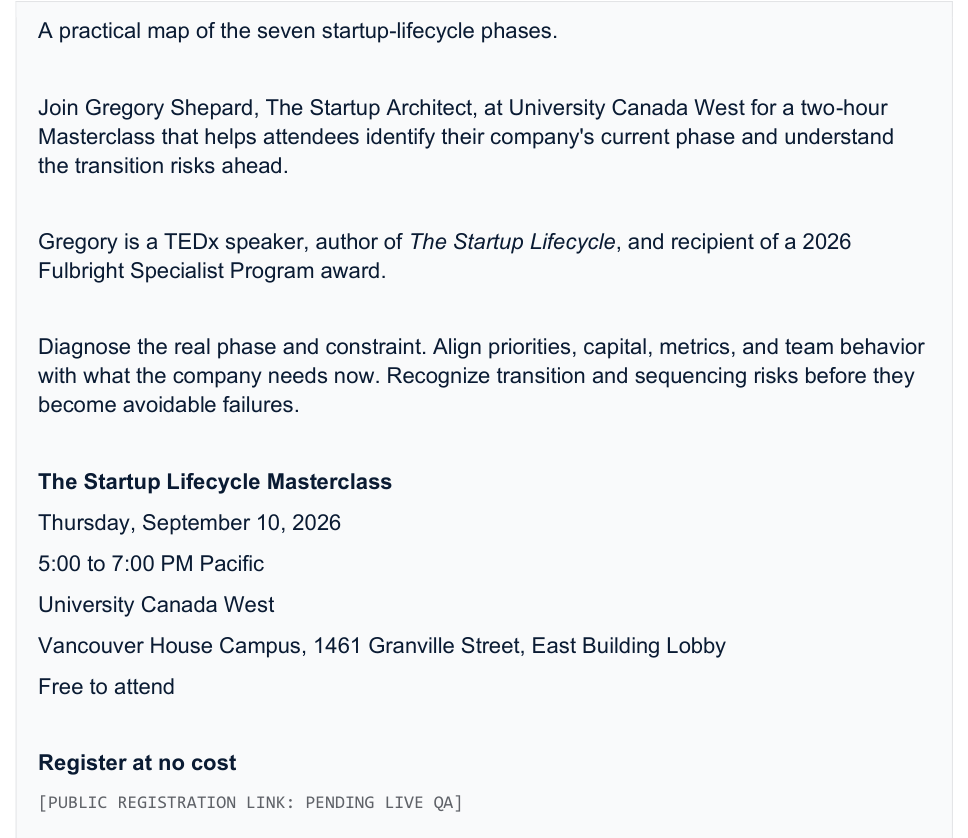
In the UCW masterclass campaign, I worked on copy, registration checks and materials for the university partner. The useful choice to study is how the invitation stays connected across the event page, social-caption draft and email draft.
The page gives the founder’s problem room to be understood: effort aimed at the wrong startup phase. The social draft leads with a practical map of the seven startup-lifecycle phases. The email subject adds Vancouver, then the body develops what the session is designed to help attendees understand. Each piece points back to the same session.
The draft action, “Register at no cost,” continues that invitation. The channel changes the amount of explanation, while the event and practical promise stay consistent. A reader following the invitation should not have to work out whether the destination is about a different session or benefit.
The original social-caption excerpt below lets you inspect that wording. The connected campaign example puts the page, post and email together. The retained page was published; the post and email are review drafts with link placeholders. The example shows how the invitation was written across the materials. It does not measure attendance or sales.
Apply the same check to your service: read a post, then the profile and destination page. Do they explain the same work to the same audience? If the post creates an expectation the profile or offer does not develop, revise that connection. Use the profile-to-inquiry diagnostic to examine the route.
5. Offer a next step that fits the post
Choose the next step from the reader's situation. A practical guide might lead to a checklist. An explanation of a defined service might lead to an inquiry. Some useful posts can simply help a reader understand a problem without a sales invitation.
An illustrative invitation for the handoff example is: "If sales and delivery keep interpreting the scope differently, start by comparing the last proposal with the kickoff brief. That is the first gap to resolve."
On a service post, you could explain what a workflow review covers and invite someone to ask whether it suits their team. Keep the invitation clear about what happens next. Avoid turning every reaction into an unsolicited pitch.
Audit five posts with this worksheet
| Check | Record for each post |
|---|---|
| Intended reader | The role and situation the post addresses |
| Problem | The decision or difficulty a buyer recognises |
| Supporting detail | The example, reasoning or work shown |
| Connection to the offer | The service a reader could reasonably associate with it |
| Next step | The invitation, if one is appropriate |
| Observed response | Relevant questions, profile visits or inquiries, with source confidence |
Do not score a post as a failure simply because it produced no immediate inquiry. A longer buying process can include several touchpoints. Record what you know without assigning every later sale to a post someone happened to like.
Choose one gap to test
If the responders are mostly outside your market, test a more relevant problem. If suitable readers respond but ask what you do, clarify the connection to your offer. If they understand the offer but hesitate, inspect the evidence, scope and first step.
Keep a dated record of the change and compare similar observation windows. Small samples need more time. A useful result could be fewer general reactions and more relevant questions, but neither direction is guaranteed.
Should I stop publishing posts that get likes?
No. Check what those posts contribute. Some build relationships, explain your perspective or reach referrers. Give buyer-relevant content a clear place in the mix rather than judging every post by the same immediate outcome.
Does a lead magnet solve this?
A resource can provide a useful next step when it addresses the same problem as the service. Downloads alone do not establish qualified demand. Track whether the people using it fit the offer and what happens afterwards.
For an actual expert-content example and how to read its response, see Ken’s practical Copilot post.
Make the profile, page and first campaign tell the same story.
If your posts, profile and service page keep introducing different versions of the business, the Founder Positioning Project brings them back to one audience and service. We agree the positioning, then I write the LinkedIn profile, one offer page, three posts and one email to introduce it.
You receive editable copy and a publishing sequence, with two consolidated review rounds. Pricing is bespoke; your proposal confirms the fee and delivery schedule. Development, publishing and ongoing management are scoped separately.

Rheanne Razo
Marketing strategist and consultant working on positioning, content, campaigns and marketing delivery for founders and growing teams.
Free profile resources
Get the LinkedIn Profile Checklist
Ten practical checks for a profile that builds trust and turns views into conversations.
No spam. Unsubscribe anytime.