Why Your LinkedIn Profile Is Not Turning Visitors Into Calls
A profile conversion audit that separates the wrong visitors from a weak offer, missing proof and a difficult next step.
On this page
A LinkedIn profile can get views without bringing in calls because visitors are the wrong fit, the offer is unclear, the evidence is weak, or the next step asks too much. Check those four things before rewriting the whole page. A view records attention; it does not tell you why someone visited or whether they were ready to buy.
This guide is for founders and consultants who already receive profile visits and want to work out where an interested buyer might get stuck.
First, separate a traffic problem from a profile problem
Look at the visitor information available to you and the people engaging with your recent posts. Are you reaching buyers, potential partners, recruiters, peers or a mix? You may not be able to identify every visitor. Record what you can observe and leave the rest unknown.
Use this diagnostic to choose your next check:
| What you can observe | What to investigate | First useful change |
|---|---|---|
| Mostly peers or job seekers visit | Audience and topic fit | Write about a problem your intended buyer owns |
| Relevant people visit but misunderstand your work | Positioning | Explain the buyer, problem and service near the top |
| People ask whether you have done this before | Credibility | Add a relevant work sample with your role explained |
| People express interest but never take the next step | Offer and friction | Make the first conversation specific and easy to understand |
These are starting hypotheses. A profile view alone cannot establish the cause.
1. Make the headline match the buyer's problem
The headline should help a suitable visitor recognise your work. Keep a useful role or specialty, then explain the problem you help with.
Illustrative rewrite:
- Before: Founder | Consultant | Business Growth
- After: Operations consultant for B2B agencies | Project handoffs, delivery systems and team accountability
The second version gives a buyer something concrete to evaluate. It also avoids promising revenue or meetings without evidence. Use the headline writing guide if you need to choose the right message.
2. Explain the engagement in the About section
After reading your opening, a visitor should understand the situation you handle and what hiring you could involve. A broad outcome such as growth needs a more specific explanation.
For an illustrative agency consultant, that opening could be:
Projects are moving, but important decisions keep getting lost between sales and delivery. I help B2B agencies review their handoffs, clarify ownership and put the agreed workflow into use.
Follow with who the service suits, the work involved and a relevant example. Keep your background where it helps a buyer assess the work.
3. Put evidence beside the claim it supports
Choose a work sample that answers the buyer's likely question. If you sell positioning, show a positioning decision and the resulting copy. If you sell campaign delivery, show the materials and explain your responsibility.
Describe the situation, your contribution and the documented result. If you cannot attribute revenue to the work, show the deliverable or decision instead of implying a revenue outcome.
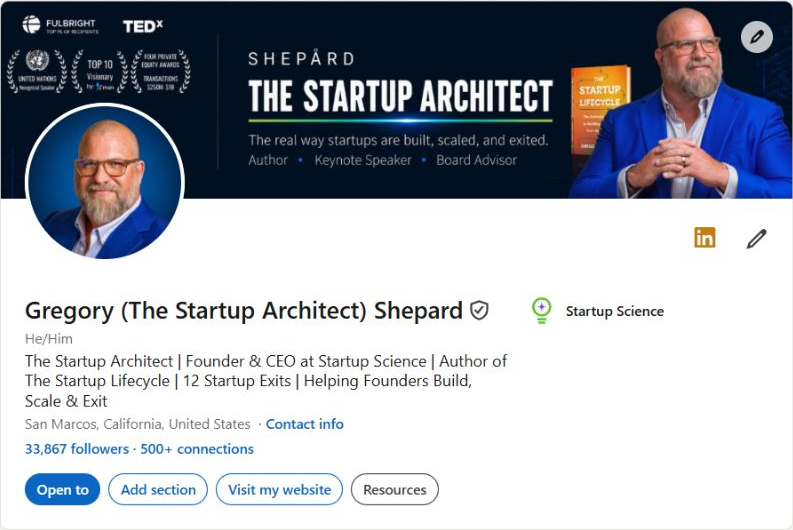
A recommendation can support credibility, but a specific example helps visitors inspect what you actually do. See the Gregory Shepard project for a work page that separates the project context from the materials.
4. Make the next step proportionate to the visitor's interest
Someone comparing possible providers may be ready to ask a question before booking a sales call. Explain what the next step involves and where it leads.
An illustrative invitation is: "Send me the part of your delivery process that keeps breaking. We can check whether a workflow review would help."
If you use a booking link, test it while signed out. Check that it opens, explains the meeting and works on a phone. Also check your contact information and any Featured links. Use the features available on your account rather than relying on a particular button being present.
5. Check that recent posts support the same offer
Read your headline, About opening and latest five posts together. Would a visitor describe the same business after reading each one? A change in direction may require new examples, not just a new headline.
If your posts attract attention from people who do not buy your service, use the engagement-to-inquiry diagnostic.
Measure the next change
Record your baseline, the date of the edit and the question you are testing. Track relevant inquiries, their source when known and what people ask about. Keep profile views as supporting context.
Review after you have enough relevant activity to learn something. If the sample is only a few visits, extend the observation period. Avoid changing your headline, audience, offer and posting approach all at once if you want to understand what helped.
Measure a defined step, with a defined denominator
Choose a cohort before calculating a rate. For example, record people who made a qualified inquiry during a calendar month and confirmed that LinkedIn was their source. Define “qualified” for your service, then follow that same group for a stated period.
Illustrative arithmetic only: eight qualified inquirers are followed for 30 days after their first inquiry. Three book a call, and two of those three attend. The inquiry-to-booking rate is 3 ÷ 8 = 37.5%. Attendance among the booked group is 2 ÷ 3, or about 66.7%. These are invented counts to explain the calculation, not performance benchmarks.
Keep pending outcomes visible. If source or person-level matching is unavailable, mark it unknown. Dividing calls by an unrelated aggregate profile-view total does not give you a measured visitor-cohort conversion rate.
| Measurement | Numerator | Denominator and window |
|---|---|---|
| Inquiry to booking | People in the qualified-inquiry cohort who book. | The same qualified-inquiry cohort, with the follow-up period stated. |
| Booking to attendance | People from the booked cohort who attend. | The same booked cohort, with pending calls identified. |
| Profile views | The platform’s reported view total. | Keep as context when you cannot connect individual views to later inquiries. |
What is a good profile-view-to-call conversion rate?
There is no single useful target for every service. Visitor intent, price, buying cycle and how you count calls all affect the comparison. Start with a consistently measured baseline for your own offer.
Should I post more before fixing my profile?
Repair a broken contact path or an unclear offer first. Then test whether your content brings suitable people to the profile. More visits will give limited information if visitors cannot tell what you offer.
For a wider check, use the B2B founder profile audit checklist.
Source and further reading
LinkedIn's guide to an effective sales profile recommends viewing the page from the buyer's perspective and connecting the profile to relevant evidence. The diagnostic and illustrative rewrites above are editorial examples, not reported client results.
Make the profile, page and first campaign tell the same story.
When the profile, offer and next step do not line up, the Founder Positioning Project gives us a defined scope for rewriting that path. We agree the positioning, then I write the LinkedIn profile, one offer page, three posts and one email to introduce it.
You receive editable copy and a publishing sequence, with two consolidated review rounds. Pricing is bespoke; your proposal confirms the fee and delivery schedule. Development, publishing and ongoing management are scoped separately.

Rheanne Razo
Marketing strategist and consultant working on positioning, content, campaigns and marketing delivery for founders and growing teams.
Free profile resources
Get the LinkedIn Profile Checklist
Ten practical checks for a profile that builds trust and turns views into conversations.
No spam. Unsubscribe anytime.